Radial Shockwave Therapy
What Is Radial Shockwave Therapy?
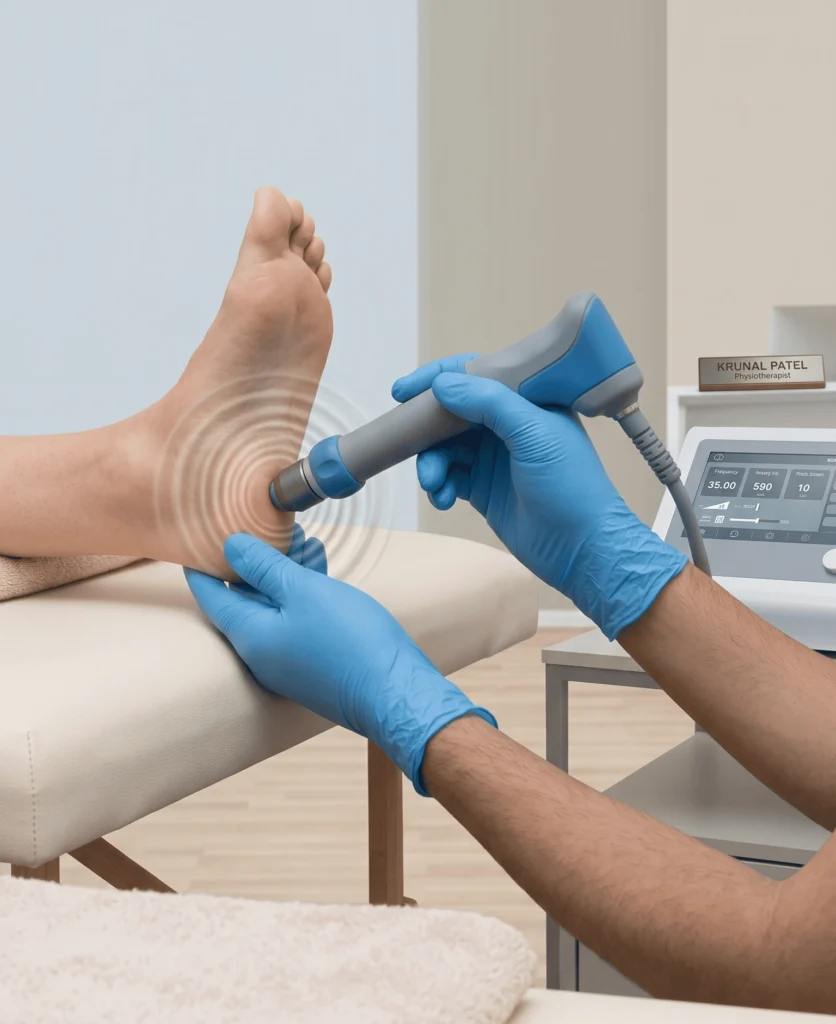
Radial Shockwave Therapy (RSWT) — a form of Extracorporeal Shock Wave Therapy (ESWT) — is one of the most significant advances in physiotherapy and musculoskeletal medicine over the past two decades. Using a handheld applicator, high-energy radial acoustic pressure waves are delivered through the skin directly into the injured or painful tissue. These waves radiate outward from the point of application, covering a broad treatment area and triggering a powerful cascade of biological responses.
The mechanical energy of these acoustic waves stimulates blood flow, disrupts calcific deposits, breaks down disorganised scar tissue, and initiates the body’s own regenerative repair processes. The result is a natural, accelerated healing response in tissue that has previously been unable to recover on its own — making radial shockwave an exceptional option for chronic, stubborn, and degenerative soft tissue conditions.
Radial shockwave therapy essentially wakes up tissue that has stopped trying to heal — converting a chronic, non-responsive injury back into an active, self-repairing state.
Why Choose Radial Shockwave Therapy?
Radial shockwave therapy offers a compelling, evidence-based alternative to surgery and corticosteroid injections for patients with chronic, treatment-resistant musculoskeletal conditions. Its benefits extend well beyond simple pain relief to genuine, lasting tissue regeneration and structural repair:
- Stimulates genuine tissue repair and collagen regeneration
- Highly effective for chronic conditions that have not responded to other treatments
- Non-invasive — no needles, no surgery, no anaesthesia required
- Physically disrupts and disperses calcific deposits
- Promotes neovascularisation — the formation of new blood vessels in healing tissue
- Provides immediate pain relief alongside long-term structural repair
- Reduces reliance on pain medication and anti-inflammatories
- Short treatment sessions with no required downtime
- Long-lasting results — healing continues weeks after the course of treatment ends
- Avoids the tissue-weakening side effects associated with repeated steroid injections
- A safe, clinically evidenced alternative for patients wishing to avoid surgery
How Radial Shockwave Therapy Works
When radial acoustic pressure waves are delivered into damaged tissue, they produce both mechanical and biological effects that collectively restart a stalled healing process. At the cellular level, shockwave stimulates the production of collagen — the primary structural protein in tendons, ligaments, and fascia — and promotes the formation of new blood vessels (neovascularisation), restoring the nutrient supply that chronic injuries so critically lack.
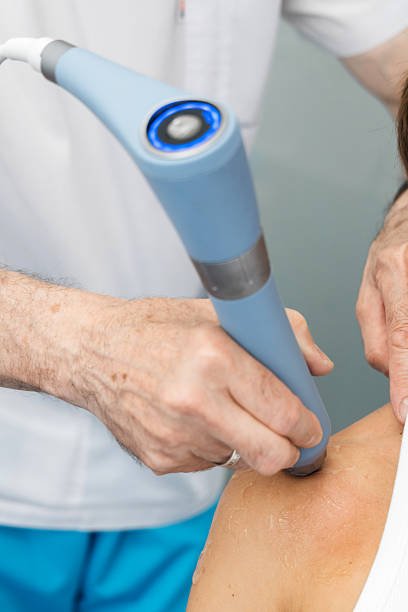
In calcific conditions such as calcific shoulder tendinitis, the high-energy radial waves physically disrupt and fragment calcium deposits, allowing the body to reabsorb and eliminate them naturally. In chronic tendinopathies and fasciopathies, shockwave disrupts the disorganised, fibrotic scar tissue that has replaced healthy tendon structure, stimulating the laying down of well-aligned collagen fibres in its place. The therapy also desensitises local pain receptors through a process called hyperstimulation analgesia, providing meaningful pain relief alongside the longer-term tissue regeneration.
Unlike corticosteroid injections — which suppress inflammation temporarily but do not repair underlying tissue damage — radial shockwave therapy actively promotes structural healing. This makes it a fundamentally different and more sustainable approach to managing chronic musculoskeletal pain.
What Conditions Does Physiotherapy Help With?
Radial shockwave therapy sessions are straightforward and efficient, typically completed within 15 to 20 minutes. The following is a step-by-step overview of what your treatment involves:
- Plantar fasciitis
- Chronic heel and arch pain caused by degeneration of the plantar fascia
- Achilles tendinopathy
- Mid-portion or insertional Achilles pain that has failed to resolve.
- Calcific shoulder tendinitis
- Calcium deposits within the rotator cuff tendons causing persistent shoulder pain.
- Rotator cuff tendinopathy
- Chronic degeneration of the shoulder's rotator cuff tendons.
- Patellar tendinopathy
- Also known as jumper's knee, affecting the tendon below the kneecap.
- Tennis elbow (lateral epicondylitis)
- Chronic degeneration of the forearm extensor tendons at the outer elbow.
- Golfer's elbow (medial epicondylitis)
- Degeneration of the forearm flexor tendons at the inner elbow.
- Greater trochanteric pain syndrome
- Persistent lateral hip pain involving the gluteal tendons and bursa.
- Hamstring tendinopathy
- Chronic high hamstring or distal hamstring pain.
- Gluteal tendinopathy
- Degeneration of the gluteal tendons at the hip.
- Tibial stress syndrome (shin splints)
- Persistent lower leg pain in active individuals.
- Myofascial trigger points
- Chronic muscle knots producing local and referred pain.
- Chronic neck and back pain
- Musculoskeletal pain patterns that have not responded to conventional treatment.
What to Expect During Your Session
1. Initial assessment
Your physiotherapist will confirm your diagnosis, review your clinical history, and assess the treatment area to determine that radial shockwave is appropriate and to identify the precise location for wave delivery.
2. Coupling gel application
A water-based ultrasound gel is applied to the skin over the treatment area. This allows the radial acoustic waves to transmit efficiently through the skin surface and into the underlying tissue without energy loss.
3. Wave delivery
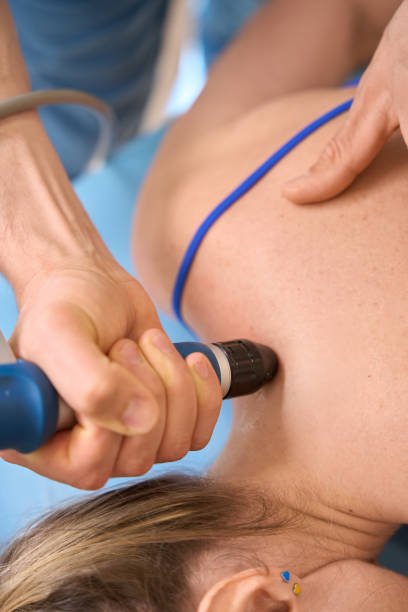
The shockwave applicator is pressed gently against the gel-covered skin and the device is activated. You will hear a rhythmic clicking or tapping sound and feel a series of pulsing pressure sensations in the tissue. The intensity is adjusted throughout the session to ensure it is both therapeutically effective and within your comfort tolerance.
4. Post-treatment guidance
Following each session, your physiotherapist will provide tailored advice on activity levels, what to expect over the following 24 to 48 hours, and any complementary exercises or strategies to support your recovery between sessions.
5. Course of treatment
Most patients require between three and six sessions, delivered once per week. Your clinical response will be reviewed after each session and the treatment plan adjusted accordingly to optimise your outcome.
Your Radial Shockwave Questions Answered
Does radial shockwave therapy hurt?
Radial shockwave therapy can cause some discomfort during the session — most patients describe it as a deep pulsing pressure or a stinging sensation over the treatment area. This is a positive sign that the waves are reaching the target tissue. The intensity is always adjusted to a level that is therapeutically effective but within your tolerance. Most patients find the discomfort very manageable, and sessions last only 10 to 15 minutes. Some temporary soreness in the area for 24 to 48 hours afterwards is normal and indicates that the healing response has been activated.
How quickly will I see results?
Results vary depending on the condition being treated and how long it has been present. Some patients notice a reduction in pain after their very first session. For most people, meaningful improvement becomes evident after the second or third session. Importantly, the greatest gains are often experienced four to eight weeks after completing the full course of treatment, as the biological repair processes initiated by shockwave continue to work long after the sessions have ended. Chronic conditions that have been present for years can still achieve excellent outcomes — the healing simply continues to build over time.
How many sessions will I need?
The standard protocol for most conditions is three to six sessions, delivered once per week. Milder or more recent conditions may respond well within three sessions. Chronic, heavily calcific, or complex presentations may benefit from up to six sessions. Your physiotherapist will assess your clinical response after each session and advise on whether additional treatment is needed. Unlike many other therapies, radial shockwave frequently produces lasting results after a single course — repeat courses are not typically necessary.
Can I exercise or continue playing sport during treatment?
In most cases, yes — though your physiotherapist will provide specific guidance based on your condition and clinical response. In the 24 to 48 hours immediately following each session, it is advisable to avoid high-impact loading on the treated area to allow the initial tissue response to settle. After that window, gentle activity and specific rehabilitation exercises are actively encouraged. A gradual, progressive return to full sport or training will be guided by your symptom response and the clinical findings at each review.
Is radial shockwave therapy safe? Are there any side effects?
Radial shockwave therapy has an excellent safety profile when administered by a trained physiotherapist following thorough screening. The most common side effects are mild and temporary — these include localised redness, minor swelling, or skin sensitivity at the treatment site, all of which typically resolve within 24 to 48 hours. Serious adverse events are extremely rare. Shockwave is contraindicated in patients with blood clotting disorders or those on anticoagulant medication, over areas of active infection, malignancy, or open wounds, over growth plates in skeletally immature patients, and during pregnancy. A thorough health screening is completed before every course of treatment.
How is radial shockwave different from therapeutic ultrasound?
Although both use acoustic energy, radial shockwave and therapeutic ultrasound are fundamentally different in their mechanism, energy level, and clinical application. Therapeutic ultrasound delivers low-energy, continuous sound waves that primarily produce a mild heating effect in tissue — useful for minor inflammation and superficial conditions. Radial shockwave delivers high-energy pressure pulses that generate powerful mechanical forces in the tissue, physically disrupting calcific deposits, breaking down scar tissue, and triggering significant biological repair and regeneration. Shockwave is considerably more powerful and is specifically indicated for chronic, degenerative, and calcific conditions where ultrasound would not be clinically sufficient.
I have had steroid injections that have not worked. Can shockwave help?
Yes — and clinical evidence strongly supports this. Radial shockwave therapy is frequently used as a second-line treatment for patients whose conditions have not resolved with corticosteroid injections, and it consistently demonstrates effectiveness in this scenario. Steroid injections work primarily by suppressing inflammation in the short term; they do not repair or regenerate the underlying degenerated tissue. Radial shockwave, by contrast, actively stimulates tissue regeneration and collagen remodelling — addressing the structural root cause of the problem rather than masking its symptoms. Many patients who have exhausted conservative options and are facing the prospect of surgery have achieved excellent, long-lasting outcomes through a course of radial shockwave therapy.
Do I need a referral from my GP or specialist?
No — you can self-refer directly to our clinic for a shockwave assessment without a GP or specialist referral. Our physiotherapists are trained to conduct independent clinical assessments, confirm the diagnosis, and determine whether radial shockwave therapy is the most appropriate treatment for your presentation. If you have recent imaging, previous investigation results, or specialist reports, bringing these to your initial appointment is helpful and allows your physiotherapist to build a comprehensive picture of your condition from the outset.